By Peter Woodford, CPA · Port Stephens Accountants & Business Advisors · Published August 2026
If you run a self-managed superannuation fund, the annual audit is not something you can skip, defer, or opt out of. It is a legal requirement under the Superannuation Industry (Supervision) Act 1993 (SIS Act), and it must be completed before you can lodge your SMSF annual return with the ATO.
Yet despite this, the audit remains one of the most misunderstood obligations for SMSF trustees — particularly around who can do it, what it actually covers, when it needs to happen, and what the consequences are if it is missed or not done properly.
This guide walks through everything you need to know about SMSF audit requirements in Australia, written for trustees who want to stay on the right side of the ATO without getting lost in the fine print. If you are based in Nelson Bay, Port Stephens, or anywhere in the Hunter region and need an independent SMSF auditor, our team at Port Stephens Accountants & Business Advisors is here to help.
Why Is a SMSF Audit Required?
Under section 35C of the SIS Act, every SMSF must be audited every year — regardless of the fund’s size, the number of members, or how simple or complex its investments are. There are no exemptions and no thresholds. If your fund is registered and active, it must be audited.
The audit exists for good reason. Unlike large superannuation funds that are regulated by APRA and have their own governance structures, SMSFs are self-regulated by their trustees. The annual audit is the mechanism through which the ATO — as regulator of SMSFs — gains assurance that funds are being run correctly and in accordance with superannuation law.
The audit must be completed before you lodge your SMSF annual return. This means you cannot lodge the return and then arrange the audit later — the audit has to come first.
What the SMSF Audit Actually Covers
The annual SMSF audit has two distinct components, often referred to as Part A and Part B:
Part A — Financial Audit
The financial audit verifies that the fund’s financial statements are accurate and give a true and fair view of the fund’s financial position. The auditor checks that:
● All assets held by the fund exist and are owned by the fund (not by trustees personally)
● Investments are recorded at their current market value, not historical cost
● Member account balances are correctly calculated and reconcile with the fund’s records
● Income, expenses, and tax have been correctly recorded and classified
● The financial statements comply with applicable accounting standards
Part B — Compliance Audit
The compliance audit tests whether the fund has operated in accordance with the SIS Act and its regulations throughout the year. This is the component that identifies operational breaches — things that may have happened during the year that put the fund outside the rules. The auditor reviews compliance with:
● The sole purpose test — is the fund maintained solely to provide retirement benefits to members?
● The investment strategy — is there a current, documented investment strategy and is it being followed?
● The in-house asset rule — do in-house assets remain below 5% of the fund’s total assets?
● The arm’s length rule — are all transactions conducted on commercial terms?
● Contribution rules — have contributions been accepted in accordance with member ages and caps?
● Pension payment minimums — if members are in pension phase, have the required minimum payments been made?
● Asset separation — are fund assets kept completely separate from trustees’ personal and business assets?
● Borrowing rules — if the fund has borrowed money, is it under a compliant limited recourse borrowing arrangement (LRBA)?
If the auditor identifies a contravention of the SIS Act that meets the reporting threshold, they are required to lodge an Auditor Contravention Report (ACR) with the ATO within 28 days of completing the audit. This triggers ATO scrutiny of the fund.
Who Can Audit Your SMSF?
Not just any accountant or financial professional can audit your SMSF.
The auditor must be:
● Registered with ASIC as an approved SMSF auditor, holding a current SMSF Auditor Number (SAN)
● Completely independent of the fund — the same person or firm that prepares your financial statements and lodges your annual return cannot also be your auditor
● Free from any financial interest in, or personal relationship with, the fund or its trustees that would compromise independence
The independence requirement is strictly enforced by both the ATO and ASIC. If your current accountant or SMSF administrator also performs your audit, this is a compliance breach that needs to be addressed immediately.
The two roles must always be kept separate.
Our team at Port Stephens Accountants & Business Advisors provides independent SMSF audit services for trustees whose accounting and administration is handled elsewhere.
We are ASIC-registered and fully independent of every fund we audit.
SMSF Audit Deadlines — When Does It Need to Happen?
The timing of your SMSF audit is governed by the lodgement deadline for your SMSF annual return.
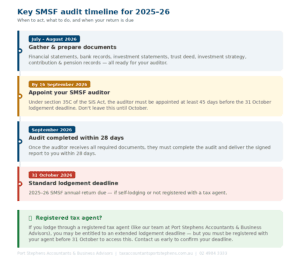
Because the audit must be completed before the return is lodged, and the auditor must be appointed at least 45 days before the return is due, the practical timeline for most funds looks like this:
What Happens If You Miss the Audit or Get It Wrong?
The consequences of failing to arrange a compliant annual audit range from financial penalties through to the complete loss of your fund’s tax-exempt status. These are the main risks trustees need to be aware of:
Administrative penalties — per trustee
Under Part 21 of the SIS Act, individual trustees and directors of corporate trustees can face administrative penalties for contraventions identified during an audit. For 2025–26, these range from $2,220 to $18,780 per contravention, depending on the severity and the specific section breached. Importantly, penalties apply per trustee — a fund with four individual trustees could face the same penalty amount multiplied by four. You should verify current penalty amounts with us or on the ATO website, as penalty unit values are subject to indexation and were due for review in July 2026.
Failure to lodge penalties
If your SMSF annual return is not lodged on time — which requires a completed audit — the ATO can issue a Failure to Lodge (FTL) penalty. These accrue per 28-day period and escalate the longer the return remains outstanding.
Super Fund Lookup status affected
A fund that is not compliant can have its status on the ATO’s Super Fund Lookup (SFLU) changed to “regulation details removed.” This is significant because it can prevent the fund from receiving employer contributions or rollovers from other funds — effectively freezing the fund’s ability to receive money until the issue is resolved.
Non-complying fund status
In serious or repeated cases of non-compliance, the ATO has the power to make an SMSF a non-complying fund. This results in the fund’s taxable income — and a tax on the market value of assets — being assessed at the top marginal rate rather than the concessional 15% rate. The financial impact is severe and can effectively destroy the benefits of having an SMSF. Verify the current applicable tax rate with us before making decisions based on this figure.
What Documents Does Your SMSF Auditor Need?
Providing your auditor with a complete, well-organised set of documents is the single biggest factor in keeping your audit straightforward and completed on time. Here is what to prepare for your 2025–26 audit:
Financial records
● Signed financial statements — statement of financial position and operating statement
● Bank statements for all fund accounts for the full financial year (1 July 2025 to 30 June 2026)
● Investment statements — brokerage statements, term deposit confirmations, managed fund distributions, and independent valuations for property or unlisted assets
● Member account statements showing opening and closing balances, contributions, and pension payments
Compliance and governance documents
● The fund’s trust deed and any amendments
● Trustee declarations (signed by all trustees — individual or corporate)
● The current investment strategy (signed, dated, and reviewed within the year)
● Minutes of trustee meetings and decisions, particularly for any significant transactions
● Details of any related-party transactions or in-house assets
Contribution and pension records
● Contribution records — showing amounts, dates, and member ages at time of contribution
● Employer contribution records or superannuation guarantee statements
● Pension commencement documentation — if any members commenced a pension during the year
● Pension payment records — showing that minimum annual pension payments were made
Prior year documents
● Previous year’s signed audit report
● Previous year’s SMSF annual return (useful for the auditor to identify changes)
Once you provide all required documents, your auditor must complete the audit and deliver the report to you within 28 days. Getting documents to your auditor early — ideally by August or September — gives everyone enough time to resolve any queries before the October deadline.
The Most Common SMSF Compliance Issues Found During Audits
The following are the compliance issues that appear most frequently in SMSF audits in Australia. Being aware of them helps you identify and address problems before your auditor does — and before they become reportable contraventions:
● No documented investment strategy, or a strategy that has not been reviewed in the current year — this is the most commonly reported contravention in SMSF audits
● Assets not held in the fund’s name — investments that were purchased in trustees’ personal names rather than in the name of the fund (or its trustee company)
● Fund bank account used for personal or business transactions — any commingling of fund assets with personal funds is a serious breach
● In-house assets exceeding 5% of total fund assets — often triggered by loans to related parties or investments in associated businesses
● Contribution amounts accepted outside the member’s eligibility — either exceeding contribution caps or accepting contributions from members who were not eligible
● Pension minimums not paid — particularly relevant for funds where members are in pension phase; the minimum pension payment must be made each year to maintain pension status
● Investment strategy not consistent with the actual investments held — the strategy must reflect what the fund is actually investing in, not just serve as a template document.
Frequently Asked Questions — SMSF Audits
Can my SMSF accountant also audit my fund?
No. The auditor must be completely independent of the fund and its trustees. The same person or firm that prepares your SMSF financial statements and lodges your annual return cannot also conduct the audit. This is an independence requirement under the SIS Act and is strictly monitored by both the ATO and ASIC. If your current SMSF accountant also handles your audit, this is a compliance breach. You need to engage a separate, ASIC-registered SMSF auditor for the audit component. Our Nelson Bay team provides independent auditing for trustees whose SMSF accounting is managed by another firm.
What is an Auditor Contravention Report (ACR)?
An Auditor Contravention Report (ACR) is a formal report that an approved SMSF auditor must lodge with the ATO when they identify a contravention of the SIS Act or its regulations that meets the ATO’s reporting threshold. The auditor must lodge the ACR within 28 days of completing the audit. An ACR does not automatically mean the fund will be penalised — the ATO reviews the circumstances and may take a range of actions from education and guidance through to formal enforcement. However, receiving an ACR does flag the fund for ATO attention, which is why addressing compliance issues proactively — before the audit — is always the better approach.
How long does an SMSF audit take?
Once your auditor has received all the required documents, they are required to complete the audit and deliver the signed audit report to you within 28 days. In practice, straightforward audits with complete, well-organised records are often completed faster than this — sometimes within a week or two. Delays most commonly occur when documents are missing, investments need additional valuation evidence, or the auditor has queries that require follow-up. The best way to keep your audit fast and efficient is to prepare a complete document package before you contact your auditor, rather than sending documents piecemeal over several weeks.
Disclaimer
This article is intended as general information only and does not constitute financial, legal, or taxation advice. The ATO rules, penalty amounts, and SIS Act provisions referenced in this post reflect our understanding at the time of writing (August 2026). Penalty unit values were due for CPI indexation in July 2026 — verify current figures with us or on the ATO website before making compliance decisions. Always obtain advice specific to your fund’s circumstances from a qualified professional.