By Peter Woodford, Port Stephens Accountants & Business Advisors · Published October 2026
If your business is registered for GST, you already know the BAS is a regular obligation. What many small business owners in Port Stephens and Nelson Bay are less clear on is exactly when it is due, what happens if you miss it, and whether there is any flexibility in the deadlines if you work with a registered BAS agent.
This guide covers the key dates, the penalty structure, and the most common mistakes that catch small business owners out — so you can stay on top of your obligations without the stress.
Who needs to lodge a BAS?
Any business registered for GST in Australia must lodge a Business Activity Statement. GST registration is compulsory once your annual turnover reaches $75,000 ($150,000 for non-profit organisations). Below that threshold, you can register voluntarily — though most businesses in a growth phase do.
Your BAS reports GST collected on sales, GST credits on business purchases, PAYG withholding from employee wages, and PAYG income tax instalments if applicable. Some businesses also report fringe benefits tax instalments and fuel tax credits through their BAS.
Even if you had no sales or purchases in a quarter, you are still required to lodge a nil BAS by the due date. A nil BAS can be lodged quickly by phone on the ATO’s automated lodgement line (13 72 26), but it must still be lodged.
BAS due dates 2025–26 — quarterly
Most small businesses with a GST turnover under $20 million lodge quarterly. The standard due dates and the extended dates available if you lodge through a registered BAS agent or tax agent are:
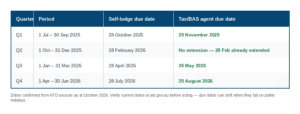
For businesses that lodge online through the ATO’s Business Portal or accounting software like Xero, there is also a two-week online lodgement concession for Q1 and Q3 — but lodging through a registered agent is generally the more reliable path to an extended deadline.
Monthly BAS — who it applies to
If your annual GST turnover is $20 million or more, you are required to lodge monthly. Monthly BAS is due on the 21st of the month following the reporting period — so July’s BAS is due 21 August, August’s is due 21 September, and so on. The exception is the December monthly BAS, which is due 21 February (not 21 January).
Some businesses below the $20 million threshold also choose to lodge monthly — typically those that regularly claim GST refunds and want faster access to those credits. If you are unsure whether monthly or quarterly is the right cycle for your business, our Nelson Bay team can advise.
What happens if you miss a BAS deadline?
Missing a BAS due date — even by one day — can trigger a Failure to Lodge (FTL) penalty from the ATO. The penalty applies per 28-day period the BAS remains outstanding, up to a maximum of five penalty units.
For small businesses in 2025–26, the base penalty unit is $330 per unit, making the maximum FTL penalty $1,650. Note that the penalty unit value for individual tax returns increased to $364 from 1 July 2026 — verify whether this also applies to your BAS obligations with us or directly with the ATO, as the rates applicable to BAS can differ.
Three things worth knowing about the BAS FTL penalty:
● It applies even if your BAS results in nil GST owing or a refund. The penalty is for not lodging on time, not for not paying.
● Lodging the BAS by the due date but not paying immediately avoids the FTL penalty. You will still owe the GST amount plus the General Interest Charge (GIC) from the due date — but the FTL penalty is avoided. The GIC rate is set quarterly by the ATO; as of the most recent quarter it was approximately 11% per annum, but verify the current rate at ato.gov.au.
● If you have a strong compliance history and this is your first missed deadline, you can request penalty remission from the ATO. There is no guarantee of remission, but it is worth asking.
One change small business owners need to know about from July 2026
From 1 July 2026, superannuation contributions must be paid to employee funds at the same time as wages — not quarterly as previously allowed. This is a significant change for businesses that have historically paid super at the end of each quarter. Late super payments attract the Superannuation Guarantee Charge (SGC), which is not tax-deductible and includes interest and an administration component. This is separate from your BAS, but worth reviewing with your accountant or bookkeeper now if you pay employees.
What to do if you have missed a BAS deadline
The single most important thing is to lodge as soon as possible. The FTL penalty continues to accrue for every 28-day period the BAS remains outstanding, so delay makes it worse. Lodging the overdue BAS does not remove the penalty that has already accumulated, but it stops it from growing further.
Once lodged, you can contact the ATO to request remission of the penalty — phone 13 11 42 for business enquiries. If you work with a registered BAS agent, they can contact the ATO on your behalf.
If you have multiple overdue BAS lodgements and are concerned about the ATO’s response, speaking with a registered agent before contacting the ATO directly can help you approach the conversation in the right way.
Struggling to keep up with BAS deadlines?
Our Nelson Bay team provides bookkeeping and BAS preparation services for small businesses across Port Stephens — handling lodgement, making sure you claim the right GST credits, and ensuring you never miss a deadline. Call us to discuss a bookkeeping arrangement that takes this off your plate.
📞 Call 02 4984 3333
📍 First Floor, 55 Donald Street, Nelson Bay NSW 2315
Frequently Asked Questions — BAS
Do I need to lodge a BAS if I had no business activity?
Yes. If you are registered for GST, you must lodge a BAS for every reporting period, even if you had no sales or purchases and the result is nil. A nil BAS can be lodged quickly by phone on 13 72 26. Failing to lodge a nil BAS still triggers a potential FTL penalty.
What is the difference between a BAS agent and a tax agent?
A BAS agent is registered with the Tax Practitioners Board to provide BAS services — including GST, PAYG withholding, and fuel tax credits. A tax agent is also registered with the TPB and can provide all BAS services plus income tax advice and lodgement. At Port Stephens Accountants & Business Advisors, we are registered as both, meaning we can handle your BAS and your business or individual income tax return through the same firm.
Can I get an extension on my BAS due date?
Extensions are generally available through a registered BAS agent or tax agent, who has pre-negotiated lodgement program dates with the ATO. For most quarterly lodgers, this adds approximately four weeks to the standard due date (except Q2, which has no agent extension). Ad-hoc deferrals for exceptional circumstances can also be requested directly from the ATO before the due date — phone 13 11 42. Extensions are not automatic and are not available retrospectively.
I use Xero for my bookkeeping — does it lodge BAS automatically?
Xero can prepare a draft BAS from your coded transactions, but it does not lodge automatically. You still need to review the figures, confirm they are correct, and submit through the ATO Business Portal, through Xero’s direct lodgement connection (if enabled), or through your registered agent. Many small business owners prepare BAS in Xero and then have their accountant or bookkeeper review and lodge — which is a sensible arrangement that catches errors before they reach the ATO.
This post provides general information only and does not constitute tax or financial advice. BAS due dates, penalty unit values, and ATO interest rates are subject to change — verify current figures at ato.gov.au or speak with a registered agent. PSABA is a registered tax agent and BAS agent under the Tax Practitioners Board. Liability limited by a scheme approved under Professional Standards Legislation.